Craft · 5 min read
Sadu: the patterns woven into every villa.
On every bed at Ghasaq lies a throw woven by hand in a nearby village. This is the story of the loom, the weavers, and the lines that look like decoration but are really a language.
By the Ghasaq teamAutumn 2026
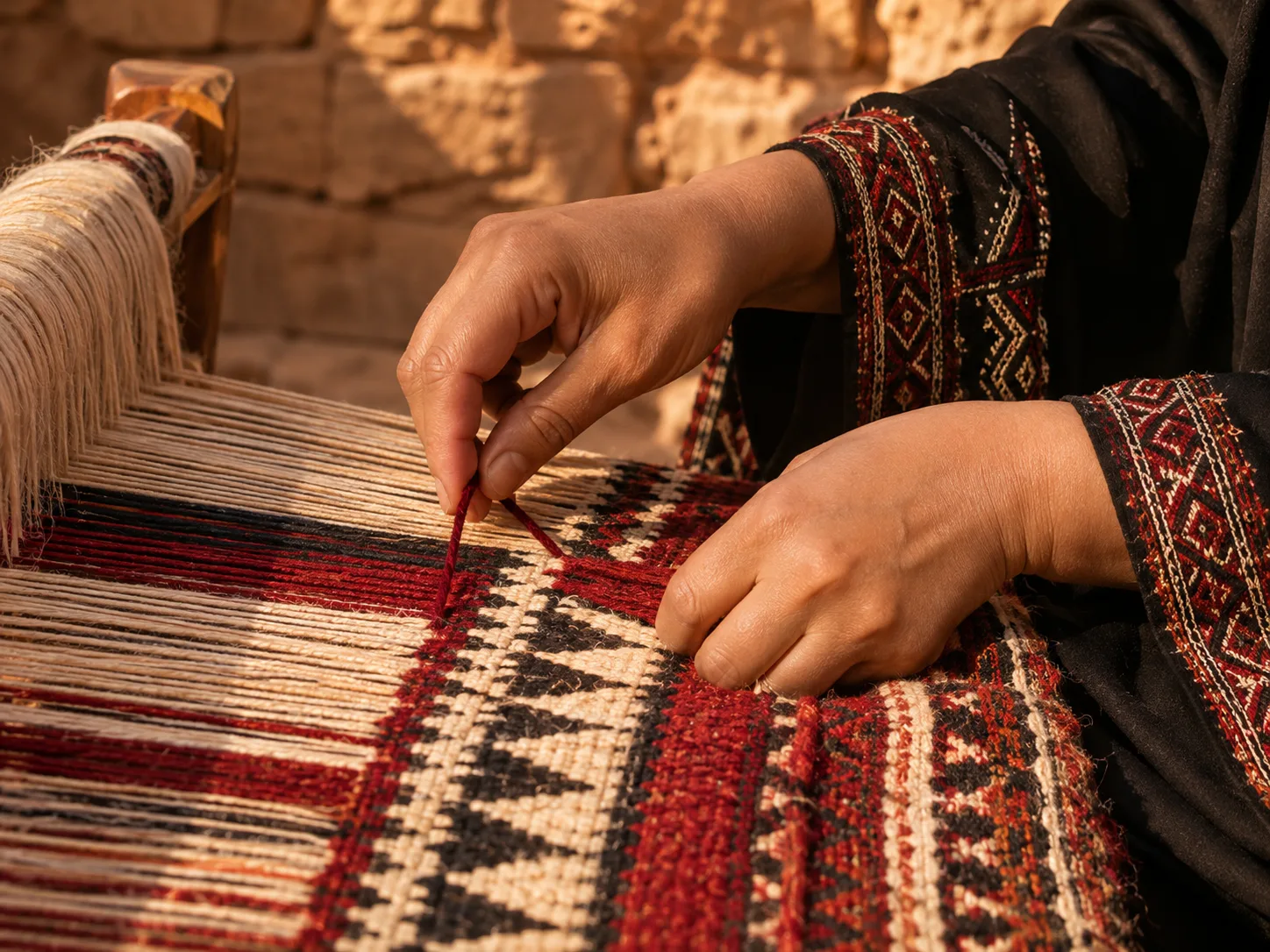
Sadu is an old Bedouin weave, made by women on a simple ground loom stretched across the sand between wooden stakes. The tent itself was once woven this way, along with cushions, belts and camel trappings. Today it is recognised as intangible cultural heritage, but before anything else it is a skill a girl learns from her mother by watching, not from a book.
The throws at Ghasaq come from four weavers in two nearby villages. They spin the wool by hand, dye it with indigo, henna and pomegranate rind, and weave each piece in about three weeks. We pay for every piece in full before it is begun, and the weaver chooses the pattern.
The colours
Red for life and hospitality, black for the goat-hair tent, and creamy white for the wool as it comes. A fourth colour appears now and then: orange, which one of the weavers calls “the colour of dusk”.
Four patterns you will find in your villa
“I don’t draw the pattern before I start. My hand knows where it goes.”
One of the Ghasaq weavers
An hour at the loom
Every day at three in the afternoon, one of the weavers sits under the palm-frond shade near the well with a small loom. You can learn a knot or a line of horse-teeth pattern and take home what you made. You can also buy a piece directly from her; the whole price is hers.

When you come back to your villa after the walk, look at the throw on the bed. Find the eye, and the horse teeth. And if you find a small orange line at the edge, know that the weaver left it there for you.